
Blueberry Filling vs Blueberry Jam: What's the Difference?
When you're in the baking aisle and come across two jars that look very similar — both of them thick, sweet, deep purple and made from blueberries — it's natural to think that they can be used interchangeably. However, if you've ever found a homemade pie turning soggy or a cake filling leaking out the sides, then you'll have come across the true solution to the question of whether blueberry filling or jam should be used: they are, in fact, two completely different products, each designed for a specific purpose. It's not just a matter of the kitchen to understand the difference between blueberry jam and filling — it's the key factor that determines whether a pastry stays together well or falls to pieces as soon as you cut into it. The following guide shows exactly where fruit filling and jam differ and how you should choose the right one depending on what you're baking.

What's the difference between blueberry filling and blueberry jam?
Blueberry filling and blueberry jam appear to be very similar at first sight since both of them use real blueberries, are cooked and sweetened, and both end up being products that are thick enough to be spooned. The actual difference, however, lies in the purpose for which each one is designed after it has left the jar.
Jam is meant to be used as a spread, for example by scooping it onto toast, stirring it into oatmeal, or eating it with a spoon; it has a soft, gel-like texture due to being set with pectin, which allows it to stay together without becoming difficult to spread. In contrast, blueberry filling is designed with baking in mind. It is thickened using starch instead of pectin and is formulated so that it remains firm and retains its shape in the oven, making it the dependable option for use in pies, pastries, and other layered desserts where a runny filling would spoil the final product.
For mothers who are baking with their children, for home bakers who want to achieve a bakery-quality finish, or for anyone who prefers to use real fruit rather than artificial additives, it is useful to know this difference at the start in order to avoid a great deal of kitchen disappointment.
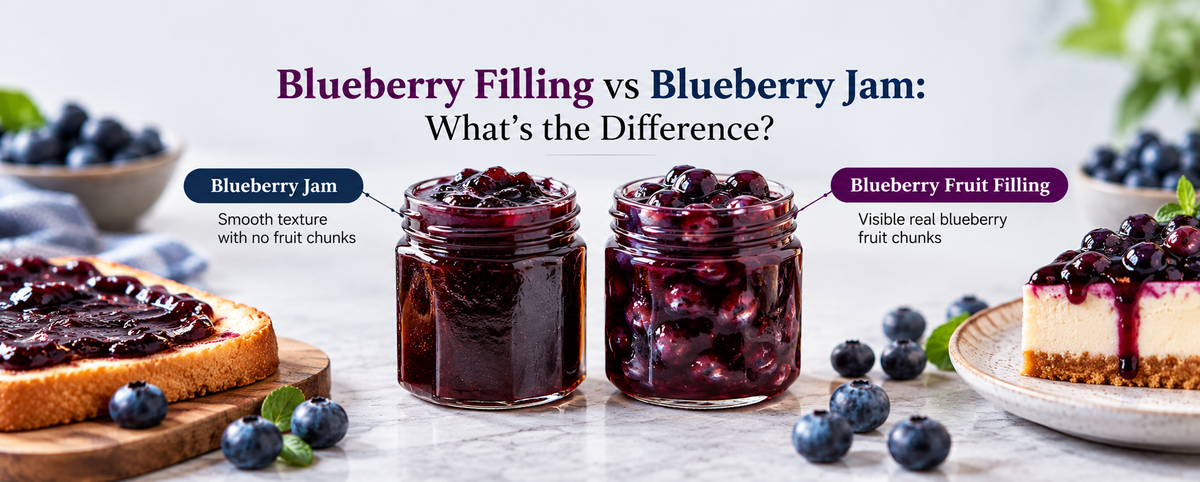
There's an opportunity in the form of a side-by-side photograph of a jar of blueberry jam alongside a jar of blueberry fruit filling, highlighting the difference in texture. The suggested alternative text is "blueberry jam and blueberry fruit filling side-by-side comparison."
Difference in Fruit Content
A clear way of telling the difference between jam and filling is by examining how much of the real fruit is still visible in the final product.
Jam: Cooked Down and Uniform.
Blueberry jam is usually cooked for a longer time and the berries are mashed or blended more thoroughly, so that the berries are broken down into a smooth and fairly even mixture. Although you may still come across some small bits of blueberry skin from time to time, the general texture is more that of a consistent, jelly-like spread than of distinct pieces of fruit.
Filling: Whole and Broken Berries Together
Blueberry filling usually keeps a greater amount of the whole berry. Instead of crushing all the berries into a paste, the recipes for the filling are designed to leave a good number of the blueberries whole, thus giving the final product visible bits of fruit. This is important in terms of both look and taste—A slice of pie containing visible berries looks and tastes more like real fruit than one with a filling that has been reduced to a smooth purée.
Why This Matters for Mothers and Home Bakers
When baking for children or when you're looking for a filling that has a true fruit flavour—not just something that's sweet and purple—the difference in the amount of fruit is one of the first things you'll notice. A filling that contains plainly visible blueberries usually seems more like a high-quality, real fruit product than one that has been processed until it has a smooth consistency.
Difference in Texture and Consistency
It is when you dip a spoon in that the difference between the blueberry filling and the jam becomes most clear.
Jam's Soft, Spreadable Set
Jam contains pectin, a fibre that occurs naturally in fruit and forms a soft, slightly springy gel when mixed with sugar and heated. This is what gives jam its characteristic spreadable consistency—firm enough to keep its shape in a jar yet soft enough to slide smoothly over a slice of toast without tearing it.
Filling's Thick, Stable Set
Fruit fillings achieve their thick, glossy texture by using a starch-based thickener, this being most often cornstarch or a bakery-grade modified starch. Unlike pectin, starch thickeners retain their structure when the filling is baked or reheated, which is the reason why the filling stays in the pastry and does not drip out.
Side-by-Side Comparison
|
Attribute |
Blueberry Jam |
Blueberry Filling |
|
Thickener |
Pectin |
Cornstarch or modified starch |
|
Texture |
Soft, spreadable gel |
Thick, glossy, spoonable |
|
Fruit pieces |
Mostly broken down |
Whole and partially broken berries |
|
Best surface |
Spreads on bread, toast |
Holds shape inside baked goods |
Difference in Sweetness
The two products also have different levels of sweetness, mainly since they are intended to be eaten in different ways.
Jam Is Built to Stand Alone
Jam is generally eaten by itself—for example, by being spread on toast, stirred into yogurt, or taken straight from the jar—and as a result, it is usually sweeter, containing enough sugar to make it satisfying when eaten on its own.
Filling Is Built to Complement
Fruit filling is generally served together with another ingredient such as pastry dough, cake layers, or a pie crust, the latter of which contributes its own sweetness to the final dessert. The filling is therefore usually made only slightly less sweet than jam, so that the tartness of the blueberries can be more clearly appreciated when combined with the sugar already in the surrounding baked good.
What This Means in Practice
You'll probably find that the resulting dessert is cloyingly sweet if you ever put jam into a recipe that calls for filling. This is because the sugar content in jam is set for consumption on its own, not for use in a pastry or cake that is already sweet.
How Blueberry Filling Performs During Baking
It is at this point that the distinction between blueberry jam and filling changes from one of personal preference to one of actual results.
Filling Holds Its Shape Under Heat
Starch-based thickeners are selected for use in fruit fillings since they stay stable at oven temperatures; as the pie bakes, the filling thickens more and sets to form a firm, sliceable layer instead of thinning out or leaking through the crust.
Filling Resists Weeping and Leaking
The liquid that is known as 'weeping' is much rarer in the case of fruit filling that has been properly made than it is with jam, since the starch thickener holds in the moisture more effectively than pectin does when the heat is sustained.
Filling Freezes and Reheats Well
Since starch maintains its structure when the temperature changes, fruit filling can be frozen, thawed, and then reheated without breaking down like pectin-set jam sometimes does. It is therefore a practical option for batch baking or for preparing desserts in advance, something that busy mothers and home bakers who are preparing for holidays or events will appreciate.
Why Jam Struggles in the Oven
Pectin gels are more sensitive to heat than starch is. If jam is left in an oven for a long time, it tends to become looser and thinner, which is the reason why a pie made with jam rather than with the right kind of filling usually ends up being runnier than desired, the crust taking in the extra liquid and thus losing its crispness.
Can blueberry jam be used as a substitute for fruit filling?
It's a question that often comes up, particularly among home bakers who have to work with the ingredients already in their pantry, and the straightforward reply is that it sometimes works, but with actual compromises.
When It Might Work
In the case of recipes that do not require prolonged baking—such as a quick stir into the batter, a light drizzle over pancakes, or a no-bake dessert—jam can substitute quite well, because it won't be subjected to the kind of continuous heat that causes it to break down.
When It Won't Work
When making pies, hand pies, tarts, or any other kind of baked good in which the filling has to keep its shape, jam should be regarded as a risky alternative since its weaker and heat-sensitive set causes it to be more likely to leak, make the crust moist, or leave the filling with a firmness that never properly develops.
A Simple Fix If You Only Have Jam
When fruit filling is not available, and you have to use jam in a baked recipe, it is possible to improve its ability to hold together by whisking in a small quantity of cornstarch that has been dissolved in cold water before baking; this in effect, turns the jam into a substance more like a proper filling. It will not be exactly the same, but it does provide a reasonable solution in an emergency.
Which Is Better for Cakes, pastries, and Desserts?
This question is impossible to answer without knowing exactly which product you want to make, because both jam and fruit filling are better suited to some specific cases.
Where Fruit Filling Shines Best
- Cakes – fruit filling used between the layers gives the cake moistness and concentration of the taste without affecting the cake itself.
- Pastries – fruit filling gives the ability to hold together when baking danishes, turnovers, and hand pies without dripping through.
-
Pies and tarts – classic applications where the ability of the fruit filling to keep its shape is needed.
Cheesecakes – the fruit filling used after baking makes the cheesecake look professional and glossy.
Where Jam Is Used Best
- Toast, scones, and biscuits – jam is perfect for being spread on top of these products.
- Yogurt and oatmeal – a spoon of jam in a bowl of oatmeal or yogurt makes the meal sweeter without the necessity of having structural properties.
- Thumbprint cookies – the amount of jam for such cookies is small, and it won't be affected by baking.
- Glazing – jam diluted with water can become a glaze for any cakes or pastries that do not require fruit filling.

How to Choose Between Blueberry Filling and Jam
A few practical questions will allow you to make up your mind quickly, whether you are filling your pantry for ordinary baking or looking for a jar for a particular recipe.
What Are You Making?
When the recipe calls for baking, layering, or slicing, go for the filling, but if it requires a spread, a stir-in, or only a light topping, then jam is more appropriate.
For how long will it be subjected to heat?
The more time something is baked, the more essential it becomes to have a filling based on starch. Recipes with a short baking time or those that are no-bake allow the jam more scope to set without breaking down.
Would you like your fruit to be visible, or would you prefer a smooth spread?
If you want the bakery-style effect with the berries clearly visible, then the filling will give you a chunkier and fruitier result. But if your aim is a smooth and even texture, jam is the better choice.
Looking for a premium product made from real fruit?
It is the quality that matters more than the label indicating jam or filling. Regardless of the option you take, look for one that uses real blueberries—preferably of the quality known as IQF (individually quick frozen)—rather than artificial flavouring or a large amount of filler, particularly when you are baking for your family and want a result that is truly fruit-forward.
Final Thoughts
Even though blueberry filling and blueberry jam may seem similar when they're on the shelf, once you know the real difference between blueberry jam and filling—especially when it comes to the amount of fruit, texture, sweetness, and how each holds up when heated—deciding which one to use in your recipe becomes much simpler. Filling is designed with structure and baking reliability in mind, whereas jam is made for spreadability and to have a strong, standalone flavour, and all you really need to do is understand which task you're trying to accomplish in order to achieve consistent results every time. Whether you're making a pie for your family or are searching for a high-quality, real-fruit spread to have at breakfast, selecting a product that was actually designed for your recipe makes a real difference. [INSERT CTA ACTION] to discover real blueberry fruit filling made with high-quality IQF blueberries for your next baking venture.




Share:
What Is Blueberry Fruit Filling and How Is It Used?
Edamame Health Benefits: Nutrients, Facts, and How It Compares to Other Beans