


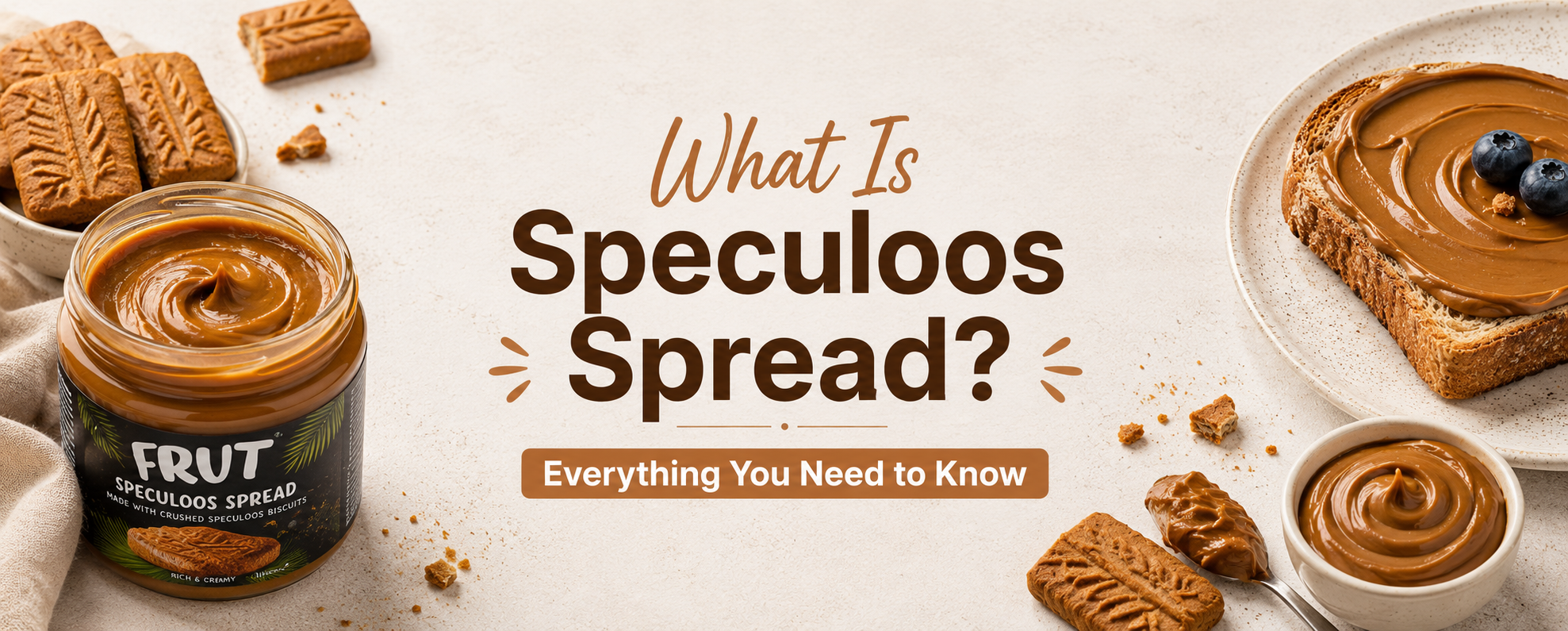
What Is Speculoos Spread? Everything You Need to Know

If you've passed a jar of caramel-coloured spread that has 'speculoos' printed on the label and have then asked yourself what it really is, you're by no means alone. Over the last ten years, speculoos spread has gone from being a speciality food item in Europe to becoming a standard item on shelves in grocery stores all around the world, even though so many people still don't know what distinguishes it from peanut butter, Nutella, or the 'cookie butter' jars which are situated right beside it. This article explains exactly what speculoos spread is, what it tastes like, how it is made, and the way that companies such as FRUT deal with it differently from the original Belgian version. By the end, you will know exactly what you're purchasing — and why it deserves a place in your pantry.
Exactly, what is speculoos spread?
Speculoos spread is a sweet and spreadable paste which is made by grinding speculoos biscuits — that is, spiced, caramelised cookies with origins in Belgium and the Netherlands — into a smooth, buttery texture. The biscuits have been baked for centuries, traditionally during Christmas and on Saint Nicholas Day, using a mixture of cinnamon, nutmeg, cloves, and brown sugar, which gives them their characteristic warm taste and rich amber colour.
There must have been a moment when people noticed that when the biscuits were ground up with a little oil and sugar, the result was more like a spread than a crumb. This product was eventually made available on the market, and Lotus Bakeries, the Belgian company responsible for the popular Biscoff biscuit, was one of the first to promote it worldwide under the name Biscoff spread. Ever since then, other companies, such as FRUT, have launched their own versions, all based on the same fundamental concept—that is, to take the taste of a caramelized spiced cookie and turn it into something that can be spread on toast, swirled into batter, or eaten directly from the spoon.
It should be pointed out that the speculoos spread is not a single item that is trademarked; it is a category. Just as 'chocolate spread' includes everything from store-brands to high-end hazelnut mixes, so too does speculoos spread encompass a variety of products that differ slightly in their level of sweetness, texture, and spice intensity according to the brand.
Where the Name Speculoos Comes From
The term "speculoos" (it is also sometimes spelled "speculaas" in Dutch) is thought to come from the Latin word "speculum", which means mirror, since this is the name given to the carved wooden molds that were traditionally used for imprinting patterns onto the biscuits before baking; alternatively, it may be derived from the Latin word "species", referring to the mixture of spices in the dough. In any case, the name has been used in Belgium, the Netherlands and large parts of continental Europe for hundreds of years, long before the spread version appeared.
What Does Speculoos Spread Taste Like?
If you've never had it, picture a mixture of caramel, brown sugar, and gingerbread, with a smooth and slightly grainy texture like that of natural peanut butter. The main flavours are caramelized sugar and warm baking spices—primarily cinnamon, together with smaller quantities of nutmeg, clove, and sometimes ginger, according to the recipe used by the brand.
Speculoos spread is not as rich or cocoa-flavoured as chocolate-hazelnut spread; instead, it has a toasty, biscuit-like taste, its flavour being more in the direction of caramel biscuit desserts than that of chocolate ones. Most commercial varieties also have a slight saltiness, this helping to counteract the sweetness and prevents the spread from having a one-dimensional taste.
Texture Differences Between Brands
The consistency of different speculoos spreads is not the same. For example, the original Biscoff spread is fairly thin and pourable at room temperature, resembling a runny kind of nut butter. On the other hand, some products, such as various FRUT ones, are designed to be a little thicker and more stable, which makes them more suitable for use in baking without causing the batter to thin out too much.
You can also get both the 'smooth' and the 'crunchy' varieties, the crunchy one having small biscuit crumbs mixed into the paste to give it a crunchy texture—this is just like the difference between smooth and crunchy peanut butter.
How is speculoos spread made?

The process involved in producing speculoos spread is simpler than most people think, even though achieving the right texture on a commercial scale does require a certain level of precision.
Step 1: Baking the Biscuits
The biscuits begin with a dough composed of flour, brown sugar, butter, and a mixture of spices usually containing cinnamon, nutmeg, ginger, cloves, and sometimes cardamom; this dough is baked until it has a deep golden brown colour, causing the sugars to caramelize and thus giving the biscuits their special crispness and toasty taste.
Step 2: Grinding
When they have cooled, the biscuits are crushed into a fine crumb and are then turned into a paste. This is in principle the same as the way in which peanut butter is made from ground peanuts, except that in this case the basic ingredient is a baked cookie rather than a raw nut.
Step 3: Emulsifying
Since ground biscuits by themselves won't have a smooth and spreadable texture, producers mix in a small quantity of vegetable oil (usually rapeseed or sunflower oil) together with extra sugar in order to get the correct consistency. In certain recipes, a little salt and an emulsifier like soy lecithin are included so that the oil and the solids won't separate in the jar.
Step 4: Final Blending and Packaging
The mixture is blended until it is smooth, after which it can be used as it is to make a 'smooth' spread, or it can be mixed with additional biscuit crumbs to produce a 'crunchy' version. The packaging and sealing then take place while the mixture is still warm, since this also helps to extend the shelf life.
FRUT's method of production is based on the same general framework, although, like most brands, the exact spice ratio and biscuit recipe are kept secret. This is one of the reasons why different jars of speculoos spread—even those that fall within the same general category—can taste noticeably different from each other.
What's the difference between Speculoos Spread and Peanut Butter?
It is usual to compare speculoos spread and peanut butter since both products have the same jar shape, a spreadable texture, and are stored in the pantry. However, apart from texture, they have very little in common.
Base Ingredient
Peanut butter is produced by grinding peanuts—these being a legume and, in fact, a source of plant protein and healthy fats. Speculoos spread is made up of ground cookies, so its main ingredients are flour, sugar, and butter rather than a nut or seed. This single difference accounts for almost all the other ways in which the two spreads are distinct.
Flavor Profile
Even in its commercially sweetened versions, peanut butter has a savoury, nutty, and slightly earthy flavour. Speculoos spread is clearly sweet, its main notes being caramel and spice rather than any nuttiness. The taste would be entirely different if you substituted one for the other, even if the texture were similar.
Nutritional Comparison
Peanut butter is generally higher in protein and unsaturated fat because peanuts are calorie-dense yet nutritionally valuable. Since speculoos spread is based on cookies, it contains more carbohydrates and sugar and has a lower amount of protein. In a general way, neither of them can be said to be healthier—they just have different uses. Peanut butter is usually regarded as a source of protein, whereas speculoos spread is more often seen as a kind of dessert topping or an ingredient for baking.
Best Uses
Peanut butter is suitable for uses that are somewhat savory—for example, in satay sauces, protein smoothies, or as a simple spread on toast for breakfast. On the other hand, speculoos spread is almost entirely used for dessert purposes: it can be incorporated into brownies, served as a base for cheesecake, stirred into coffee, or combined with chocolate and caramel in baked goods.
Is Speculoos Spread the same as Cookie Butter?
Yes, in practice, speculoos and cookie butter refer to the same thing. The only difference is that it's a matter of regional terminology and not one of the ingredients or the method of production.
In Belgium and a large part of Europe, the product is known as speculoos spread or speculoos paste, a name that is directly associated with the biscuit it is made from. In the United States, "cookie butter" became the more commonly used term following the introduction by Trader Joe's of its own version with that name, a move which helped get the product accepted by American customers who were previously unfamiliar with speculoos biscuits.
Certain brands apply the two terms in the same way on their packaging in order to appeal to both groups of consumers, whereas others—such as several of FRUT's product lines—go with 'speculoos spread' or 'caramel biscuit spread' in order to remain closer to the product's European origins. However, in terms of taste, if a label refers to it as cookie butter, you can expect the same caramelised, spiced flavour profile as with one that is labelled speculoos spread.
Is Biscoff the same as Speculoos spread?
It is from this source that much confusion arises. Biscoff is a brand name belonging to Lotus Bakeries and should not be regarded as a general term for the product. Biscoff spread is a type of speculoos spread, just as all Kleenex is tissue, but not all tissue is Kleenex. Other brands, such as FRUT, have their own speculoos with their own recipe and spice mixture.
How to Store Speculoos Spread Properly

Storage is easier than the average person anticipates, but there are a few habits that have a noticeable effect on both texture and shelf life.
Keep It at Room Temperature
The majority of commercial speculoos spreads are shelf-stable and do not need to be refrigerated, just as with peanut butter or Nutella. You should keep the jar in a cool, dry pantry, away from direct sunlight and heat sources, for example, above the stove or near a window.
Seal It Tightly After Each Use
Since the spread contains oil, it can gradually dry a little at the surface when exposed to air, resulting in a thicker and less easy-to-spread layer. Make sure to screw the lid on tightly after using the jar and avoid keeping the jar open for long periods.
Avoid Introducing Moisture
Taking the spread out of the jar with a wet spoon or knife may cause moisture to get into the jar, thus raising the chances of mold developing later on. Although it is a minor habit, it is one of the most frequent causes of a jar going bad before the expected shelf life.
Refrigeration Isn't Necessary — But It's Not Harmful Either
It is preferable for some people to store their speculoos spread in the refrigerator, especially in hot climates, so that it doesn't become too soft or oily on the surface. While this is acceptable, refrigeration will greatly firm up the texture and make the spread quite hard to spread when taken directly from the fridge. So, if you choose to refrigerate the spread, allow it to stand at room temperature for ten to fifteen minutes before using it, or warm it gently to regain a spreadable consistency.
For how long does speculoos spread last?
Unopened Jars
An unopened jar of speculoos spread will generally remain suitable to eat for about 12 to 18 months from the date it was manufactured if it is stored in a cool, dry pantry. You should always look at the best-before date printed on the package, as this can differ slightly depending on the brand and formulation.
Opened Jars
As long as the jar is tightly sealed and stored away from both heat and moisture, most opened speculoos spreads will remain satisfactory for about 2 to 3 months at room temperature; refrigerating the opened jar may slightly increase the duration, although it will have the same effect on the texture as already mentioned.
Signs It's Gone Bad
Speculoos rarely spoils in a dramatic way, but there are a few signs that tell you it's time to discard the jar: if it gives off a sour or unusual odour that wasn't there before, if there is visible mould on the surface, or if the texture has separated in a manner that doesn't come back together when you stir it. It is normal for some natural oil separation to occur, and this is not a sign that the speculoos has gone bad — merely stirring it quickly will generally solve the problem.
A Quick Word on How to Use Speculoos Spread
After you have obtained a jar of speculoos spread, and it's in the pantry, the natural question to ask is what else you can do with it besides toast. It mixes well into oatmeal, can be incorporated into brownie batter, serves as a base for a cheesecake, or can be blended into coffee and milkshakes to give a caramel biscuit flavour that is difficult to achieve using syrups alone. If you would like a complete list of ideas, our guide on [15 ways to use speculoos spread] gives you breakfast alternatives or dessert recipes.
Conclusion
Speculoos spread is not merely a fashionable jar placed alongside peanut butter and Nutella – it is a truly unique product with its own history, taste characteristics, and best applications in the kitchen. Knowing what it's made of, how it compares to cookie butter and peanut butter, and how to store it makes it much easier to get the most out of each jar. Whether you choose a well-known brand or decide to try FRUT's version of this caramel biscuit spread, the basic facts remain the same: it has a warm, spiced, caramelised flavour which is just as suitable for your morning coffee as it is for a weekend baking effort. If you're wondering what to do with it, why not give FRUT's speculoos spread a try in your next batch of cookies, cheesecake, or coffee—typically one jar is enough to explain why people keep asking for more.
Click Here to Buy Now





Share:
Are Frozen Cranberries Good for You? A Complete, Evidence-Based Guide
What Is Blueberry Fruit Filling and How Is It Used?