


What Is Blueberry Fruit Filling and How Is It Used?
Everyone who has eaten a pastry and come across that thick, shiny section of deep purple fruit has tasted blueberry filling — a smooth, spoonable mix designed to hold its shape in baked goods rather than being spread on toast. It is found in pies, danishes, cheesecakes, and a great many other desserts, but most people have never taken the time to find out what it's made from or how it differs from the jam that is next to it on the shelf. This article explains precisely what blueberry fruit filling is, the ingredients used to make it, how it compares to jam, what it tastes like, and the various ways bakers use it. If you're seeking a method of adding a genuine fruit flavour to your baking or snacking without having to choose something too processed, then a proper understanding of this ingredient is a good starting point.
What is blueberry fruit filling?
Blueberry fruit filling is a thickened and cooked mix of blueberries that is meant to remain firm and keep its shape after being baked or cooled, rather than running or soaking into the thing it is combined with. Different from syrup or compote, which remain runny and pourable, fruit filling has a set, spoonable texture that makes it suitable for being layered into pastries, pies, and cakes without causing the surrounding dough or crust to become soggy. The fruit fillings used commercially are generally made with IQF blueberries — that is, blueberries which are individually quick-frozen and flash-frozen shortly after being harvested so as to retain their colour, texture, and flavour before being reduced to make the final filling.

What is the blueberry fruit filling made from?
Essentially, blueberry fruit filling is made up of a rather simple mix of ingredients, although the specific recipe differs between home-made and commercially produced versions.
Core Ingredients
- Blueberries: The filling is generally based on IQF blueberries in commercial production since flash-freezing preserves the quality of the fruit between harvesting and processing better than standard frozen or shelf-stable options.
- Sugar: Sugar is added in order to provide sweetness and also to counteract the natural tartness of the berries.
- Cornstarch is commonly used in homemade fruit fillings. FRUT Blueberry Fruit Filling uses modified starch, formulated to provide a smooth, glossy texture and a stable consistency that holds up well in baking and other applications.
- Water or fruit juice is used in order to help dissolve the thickener and to control the final consistency.
Lemon juice serves to balance the sweetness and enhance the overall flavour, as well as aid in the preservation of the filling's colour.
Why IQF Blueberries Matter
Using individually quick-frozen blueberries instead of fresh, canned, or ordinary frozen fruit enables manufacturers to maintain a high level of consistency and quality throughout the year. Since IQF berries are frozen separately rather than being frozen in a block, they thaw out evenly and keep more of their structure, so the final filling has a more uniform texture and a more authentic blueberry flavour than one made from lower-quality types of fruit. This is one of the reasons why fruit filling made with real IQF blueberries usually tastes noticeably fresher than mass-produced, artificially flavoured alternatives.
What Makes Blueberry Fruit Filling Different From Blueberry Jam?
It is one of the most confusing points because both products are thick, sweet, blueberry-based spreads and can appear similar when placed next to each other on a shelf. However, the differences become important when you know the purpose for which each one was designed.
Texture and Set:
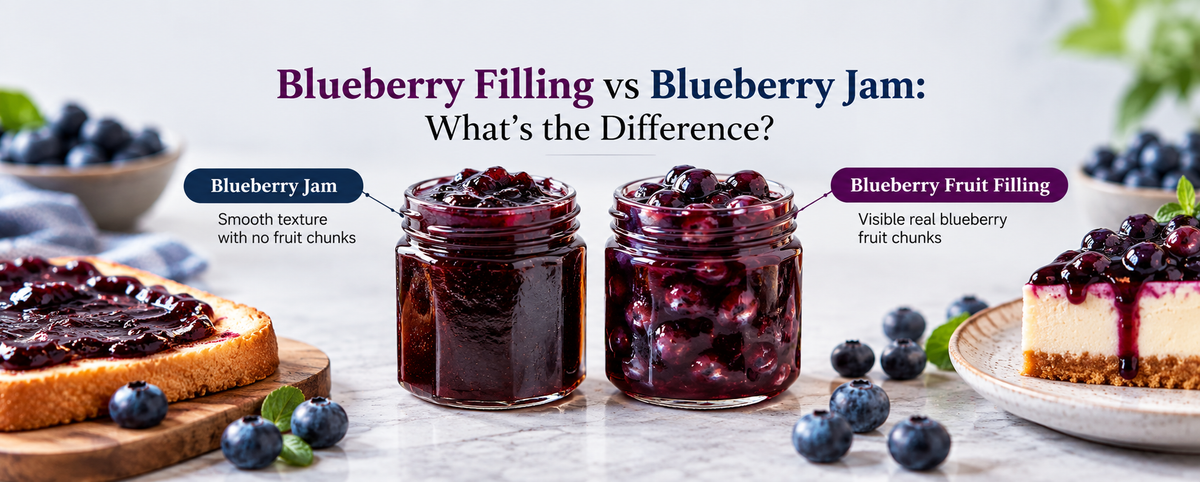
Jam is generally smoother and easier to spread, having been thickened with pectin until it reaches a soft, gel-like consistency that spreads easily over bread or toast. By contrast, the fruit filling is much thicker and firmer, being thickened with a starch rather than pectin, which enables it to retain its shape when baked into a pie or when placed in a pastry without becoming runny.
Fruit Content and Texture
Jam is typically reduced even more, which causes the fruit to be broken up more thoroughly and results in a uniform, jelly-like spread. Since fruit filling contains more whole or only partly broken berries, it has a chunkier texture with noticeable bits of fruit rather than a smooth and even consistency.
Baking Stability
For bakers, this is the most important practical difference. Since jam tends to thin out and lose its shape when it is heated in an oven, it can result in baked items becoming soggy or cause the fillings to leak. Fruit filling, on the other hand, is designed so that it maintains its set both when baked and when frozen, which is the reason it is preferred when making pies, turnovers, and other baked desserts in which structural integrity is important.
Sweetness Level
Jam is usually sweeter because it is intended to be eaten in small spoonfuls by itself. Fruit filling is often a bit less sweet since it is meant to be served with pastry, cake, or a crust, which contributes its own sweetness to the final dessert.
What Does Blueberry Fruit Filling Taste Like?
The blueberry fruit filling provides a deep and strong blueberry flavour — it is sweeter and more intense than that of fresh berries, yet has a mild tartness which prevents it from seeming flat or one-dimensional. During the cooking process, the berries soften, and their natural juices are drawn out, giving a richer and more rounded taste than that of the raw fruit, and the lemon juice usually called for in the recipe contributes a slight brightness that keeps the sweetness in balance. In some cases, you may also detect faint hints of vanilla or cinnamon, but a good filling must always have a dominant blueberry flavour, the other flavourings merely acting as a supportive element rather than overwhelming the fruit itself.
It has a smooth texture yet is not uniform since most of the fillings contain whole or partly broken berries, giving you areas of real fruit together with the thick, syrupy base. The fact that there is a contrast between the soft, cooked berries and the glossy filling around them is one of the reasons why the conserve feels different from both jam and a plain fruit sauce.
How Do People Use Blueberry Filling in Baking?
Blueberry fruit filling is accepted in a baker's kitchen since it behaves reliably when heated and can easily be incorporated into various types of desserts.
As a Pie and Tart Filling
The most conventional method involves pouring the filling into a ready-made crust and then baking it until the top turns golden and the filling is gently bubbling at the sides. The filling being already thickened means that it sets correctly while baking without making the crust become soggy.
In Hand Pies and Turnovers
The firm set of the fruit filling makes it suitable for use in hand-held pastries since a looser filling such as jam would leak out when baking; a spoonful enclosed in a folded pastry remains intact throughout the baking process.
As a Cake or Pastry Filling
Blueberry filling is usually placed between the layers of cake or inserted into pastries such as danishes and croissants, where it contributes both moisture and flavour without causing the adjacent dough to become soggy or unstable.
As a Cheesecake Topping
Blueberry fruit filling is poured over the baked and chilled cheesecake, where it provides colour, sweetness, and texture, and because of its thick consistency, it remains on top rather than running down the sides.
As a Swirl-In Ingredient
Certain bakers mix the fruit filling directly into the muffin or cake batter before baking, which results in the finished product having pockets of intense blueberry flavour rather than having the flavour concentrated in one layer.
What kinds of desserts are you able to prepare using blueberry filling?
Once you have some blueberry fruit filling to hand, there are all sorts of possibilities available to you beyond a traditional pie.
Classic Blueberry Pie or Cobbler
The classic method involves baking the filling under a solid crust, a lattice top, or a crumble topping until it becomes golden and bubbling.
Blueberry Cheesecake
Fruit filling, whether it is baked directly into the cheesecake or added on top after baking, provides a fresh, fruity contrast to the rich and creamy base.
Blueberry Danishes and Turnovers
When fruit filling is incorporated into puff pastry or Danish dough, it results in a type of bakery pastry that maintains its shape and does not leak whilst baking.
Blueberry Muffins and Cake
Fruit filling can be incorporated into the batter or placed between the layers of the cake, providing both moisture and a strong flavour without it being necessary to have a separate glaze or sauce.
Blueberry Parfaits and Yogurt Bowls
If you want a lighter and less indulgent choice, a spoonful of blueberry fruit filling mixed with yogurt and granola provides a quick and satisfying breakfast or snack—truly an excellent way of adding real fruit flavour to a healthier bowl without having to use a sugary syrup.
Blueberry Oatmeal or Pancake Topping
When it has been slightly warmed and poured over oatmeal, pancakes, or waffles, fruit filling acts as a more textured and fruit-focused option compared to ordinary syrup.
How to Store Blueberry Fruit Filling
Proper storage helps maintain the texture, flavour, consistency, and quality of blueberry fruit filling.
Refrigeration
Once opened, blueberry fruit filling should be stored in the refrigerator in a clean, airtight container and kept refrigerated when not in use. For best quality, always use a clean, dry spoon or utensil when handling the filling and avoid leaving the product at room temperature for extended periods.
Follow the storage instructions and use-by date provided on the product packaging.
Freezing
Freezing is not recommended for blueberry fruit filling. The product is formulated to provide a consistent texture and performance under recommended refrigerated storage conditions. Freezing and subsequent thawing may affect its texture and consistency.
Thawing and Reheating
Thawing and reheating are not recommended, as the product is intended to be used directly under its recommended storage conditions. For best results, keep the product refrigerated and use it as required for pies, tarts, pastries, cakes, desserts, and other bakery applications.
Signs to Know When to Throw It Away
Blueberry fruit filling needs to be thrown away in case of mold presence or any kind of off odors or changes in color and texture, which might mean spoilage of the product. It should be done because it contains sugar and moisture.


Share:
What Is Speculoos Spread? Everything You Need to Know
Blueberry Filling vs Blueberry Jam: What's the Difference?