

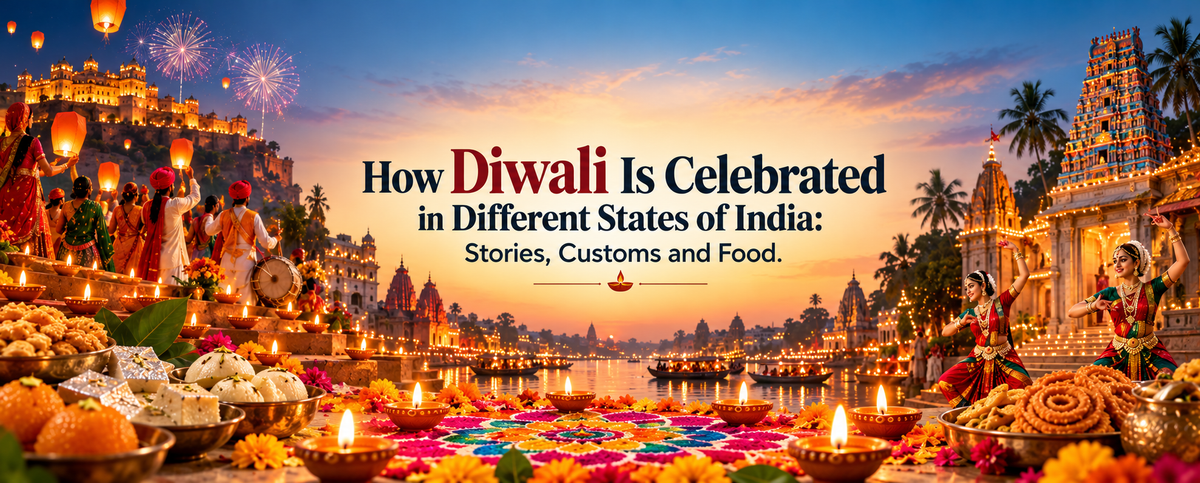
How Diwali Is Celebrated in Different States of India: Stories, Customs and Food
Diwali looks different depending on where you stand. In Ayodhya, lakhs of clay lamps glow along the river. In Kolkata, the night belongs to the goddess Kali. In Tamil Nadu, the festival begins before sunrise with an oil bath and a bite of herbal medicine. This guide shows how Diwali is celebrated in different states of India, from the stories behind each custom to the sweets and snacks that fill the table. You will see why the festival means different things to different communities, what each region eats and why, and a few easy ways to enjoy the feast without feeling sluggish or watching your skin pay for it.
Why Diwali Is Celebrated: One Festival, Many Stories

Diwali, or Deepavali (row of lamps), falls on the new-moon night of the Hindu month of Kartik, usually in October or November. Almost everyone agrees that it marks the triumph of light over darkness. What changes from state to state is the story people tell about it.
- The return of Rama. Across much of North India, Diwali celebrates Lord Rama's homecoming to Ayodhya after defeating Ravana and fourteen years in exile, when the city lit lamps to welcome him.
- Lakshmi, goddess of wealth. In many homes and businesses, the festival is above all about inviting prosperity through Lakshmi Puja.
- Krishna and Narakasura. In South India, Goa, and parts of the Deccan, the key event is Krishna's victory over the demon Narakasura, remembered on Naraka Chaturdashi.
- Kali's night. In Bengal and Odisha, the same new-moon night is devoted to Goddess Kali.
- King Bali. In Karnataka, Maharashtra, and Gujarat, the day after Diwali honours the generous demon king Bali, sent to the netherworld by Vishnu's Vamana avatar.
- Beyond Hinduism. Jains observe Diwali as the day Lord Mahavira attained nirvana. Sikhs celebrate Bandi Chhor Divas, marking Guru Hargobind's release from Gwalior Fort.
The Five Days of Diwali
Most regions follow a rough five-day arc: Dhanteras (buying metal and wealth), Naraka Chaturdashi (the day of purification), Lakshmi Puja (the main night), Govardhan Puja or Balipratipada (the day after, which is also New Year in some communities), and Bhai Dooj (honouring the bond between brothers and sisters). The names and emphasis shift from state to state, which is exactly where the variety comes from.
How Diwali Is Celebrated in North India
Uttar Pradesh: The Land of Rama's Return
Nowhere is the Ramayana link stronger than in Ayodhya. On the eve of Diwali, the Deepotsav festival lights up the ghats of the Saryu with lakhs of diyas, and the town stages Ramlila performances and a grand procession. Homes across the state place diyas in rows, draw rangoli at the door, and worship Lakshmi and Ganesha at night. Offerings of kheel and batasha (puffed rice and sugar drops) are traditional, and the sweet table features khoya-based mithai, pedas and barfis.
Punjab: Bandi Chhor Divas
For Sikhs, Diwali coincides with Bandi Chhor Divas, the "day of liberation." The Golden Temple in Amritsar glows with thousands of lamps and fireworks reflected in the sarovar, and langar feeds everyone who comes. Karah prasad, made from wheat flour, ghee and sugar, is shared in the gurdwara. At home, expect rich, warming food: sarson ka saag, makki di roti and sweets like pinni and besan laddoo.
Rajasthan: Lamps, Markets and Annakut
Rajasthan cleans and decorates with great attention. Cities like Jaipur light up entire bazaars, and women paint mandana designs on walls and floors. At the Shrinathji temple in Nathdwara, the day after Diwali is marked by Annakut, where mountains of cooked food are offered to the deity. The regional table brings mawa kachori, balushahi and dal-baati-churma, usually made with generous amounts of ghee.
Diwali in West India: Gujarat, Maharashtra and Goa

Gujarat: New Year and Business Blessings
For Gujaratis, the day after Diwali is Bestu Varas, the start of the Vikram Samvat New Year. Businesses perform Chopda Pujan, worshipping new account books, and families visit relatives to exchange wishes. Elaborate rangoli covers courtyards, and kitchens turn out a famous spread of farsan (savoury snacks): chakri, ghughra, sev, mathri, and sweet mohanthal. The cooking leans slightly sweet even in savoury dishes, a signature of Gujarati taste.
Maharashtra: Early-Morning Baths and Faral
The festival opens with Vasu Baras, when cows and calves are honoured. On Naraka Chaturdashi, families rise before sunrise for an abhyanga snan, an oil massage followed by a bath with fragrant ubtan, then light lamps and burst crackers at dawn. Colourful paper lanterns called akash kandil hang outside homes, and children build miniature forts of clay. The star of the table is faral, an assortment of homemade snacks including karanji, chakli, shankarpali, besan laddoo, and anarsa, shared with neighbours.
Goa: Burning the Demon
Goa's celebration centres on Narakasura. In the early hours, communities parade giant paper-mache effigies of the demon and set them alight, often in lively neighbourhood competitions, before families return for an oil bath. The breakfast tradition is flattened rice, or poha, in many forms, mixed with jaggery and coconut, along with sweet neureos, fried pastries stuffed with coconut and sugar. The flavours lean on coconut, jaggery, and cardamom.
Diwali in South India: Karnataka and Tamil Nadu
In the south, the festival often starts on Naraka Chaturdashi, before dawn, and the emphasis is on purification rather than fireworks at night.
Tamil Nadu: Oil Bath and Deepavali Marundhu
Tamil families rise in the pre-dawn hours, rub warm sesame oil on the body, and take a ritual bath that is considered as sacred as a dip in the Ganga. New clothes, crackers at first light, and temple visits follow. The most distinctive tradition is Deepavali marundhu (or legiyam), a paste of ginger, pepper, long pepper, cumin, and jaggery that helps digestion after the festive feasting. Alongside it come murukku, adhirasam, Mysore pak, and ribbon pakoda, usually fried in coconut or groundnut oil. Tastes lean, tangy, peppery, and jaggery-sweet.
Karnataka: Naraka Chaturdashi and Bali Padyami
Karnataka observes a ritual oil bath too, followed by the lighting of rows of lamps and the worship of cows. On Bali Padyami, people remember King Bali with rangoli, lamps, and decorated cattle. Mangalore and the coastal belt have their own versions of the festival. The table includes chiroti (a flaky, layered sweet dusted with sugar), kodubale (ring-shaped crunchy snacks), holige (sweet flatbread), and chakli.
Diwali in East India: West Bengal and Odisha
West Bengal: Kali Puja Night
In Bengal, Diwali night is Kali Puja. Thousands of pandals, from Kalighat to Dakshineswar, worship the fierce goddess with flowers, hibiscus, incense, and midnight rituals. The day before, on Bhoot Chaturdashi, families light fourteen lamps to ward off negative energy and eat fourteen kinds of leafy greens (choddo shaak), a surprisingly nutritious tradition. Sweets matter here: sandesh, rosogolla, nolen gur payesh and mishti doi, alongside luchi and alur dum at festive meals. Bengali taste favours delicate sweetness and the aroma of date-palm jaggery.
Odisha: Honouring Ancestors
Odisha adds a moving ritual. On the eve of Diwali, families burn bunches of jute stalks, called Kaunria Kathi, to guide the souls of departed ancestors and sing a prayer inviting them to bless the household. Lamps, Lakshmi Puja, and Kali Puja follow. Typical festive foods include chhena poda (a caramelised baked cottage-cheese sweet), arisa pitha and mildly spiced vegetable dishes cooked with minimal oil.
Food Style and Taste Across States, and How to Eat It Well

Regional food tells you as much about Diwali as the rituals do. Here is a quick comparison.
|
State |
Signature Diwali foods |
Taste profile |
|
Uttar Pradesh |
Kheel-batasha, khoya mithai, peda |
Milky, rich, mildly sweet |
|
Punjab |
Karah prasad, pinni, langar meals |
Ghee-heavy, hearty |
|
Rajasthan |
Mawa kachori, balushahi, dal-baati-churma |
Rich, ghee-laden, spiced |
|
Gujarat |
Mohanthal, ghughra, chakri, farsan |
Sweet-savoury balance |
|
Maharashtra |
Karanji, chakli, shankarpali, anarsa |
Crisp, nutty, lightly sweet |
|
Goa |
Sweet poha, neureos |
Coconut, jaggery, cardamom |
|
Karnataka |
Chiroti, kodubale, holige |
Flaky, sugary, mildly spiced |
|
Tamil Nadu |
Murukku, adhirasam, Deepavali marundhu |
Peppery, tangy, jaggery-sweet |
|
West Bengal |
Sandesh, rosogolla, nolen gur payesh |
Delicate, aromatic, milk-based |
|
Odisha |
Chhena poda, arisa pitha |
Caramelised, earthy, light |
Enjoying the Feast Without the Fallout
Festive food is meant to be shared and savoured. A few habits keep energy and skin steady through the week:
- Eat sweets after a proper meal, not on an empty stomach, to soften the sugar spike.
- Keep portions small and spread them out. One or two pieces a day beats a heap on one night.
- Borrow the wisdom of the south. A small spoon of ginger-pepper legiyam or a warm cup of ginger tea can ease heavy digestion.
- Add the greens. Bengal's choddo shaak tradition is a reminder to balance fried food with vegetables.
- Drink water, especially if you eat fried snacks and sugar. Both can leave skin dull and dehydrated.
- Choose baked or air-fried versions of snacks like chakli and shankarpali when you can.
- Take care with fireworks. Smoke and dust aggravate skin and breathing, so wash your face and rinse your eyes afterward.
Frequently Asked Questions
1. Why is Diwali celebrated in different ways across India?
Because the festival carries several stories: Rama's return, Krishna's victory over Narakasura, Lakshmi's blessings, Kali's worship, and Bali's legend. Each region emphasises the one that fits its history, language and local deities, and adds its own food and customs.
2. Which state has the most spectacular Diwali celebration?
There is no official winner, but Uttar Pradesh (Ayodhya's Deepotsav), Punjab (the Golden Temple's illumination) and West Bengal (Kali Puja) are among the most visually striking. Gujarat and Maharashtra are well known for lively markets and elaborate home celebrations.
3. Is Diwali celebrated on the same day everywhere in India?
Mostly yes, on the new-moon night of Kartik. However, some regions begin the main rituals a day earlier, such as the pre-dawn oil bath on Naraka Chaturdashi in the south, and the day after Diwali takes on different meanings, from New Year in Gujarat to Bali Padyami in Karnataka.
4. Do non-Hindus celebrate Diwali?
Yes. Jains mark Mahavira's nirvana, Sikhs observe Bandi Chhor Divas, and some Buddhist communities, especially Newar Buddhists in Nepal, also take part. Many families of every faith join in the lights and sweets.
5. How can I enjoy Diwali sweets without harming my health or skin?
Keep portions small, eat sweets after meals, pair fried snacks with vegetables or fruit, and stay hydrated. Traditional digestive aids such as ginger, pepper, and jaggery-based legiyam can also help after rich meals.
Conclusion
Seeing how Diwali is celebrated in different states of India makes one thing clear: the festival is a shared idea held together by many local stories. A Punjabi gurdwara, a Bengali Kali temple, a Tamil kitchen at dawn, and a Gujarati marketplace all light the same flame in their own way. Food ties it together, from kheel in Uttar Pradesh to chiroti in Karnataka, and a little mindfulness keeps the feast kind to your body. Try one new regional tradition or recipe this year and learn the story behind it.


Share:
Dried Cranberries: Nutrition, Uses & Buying Guide