


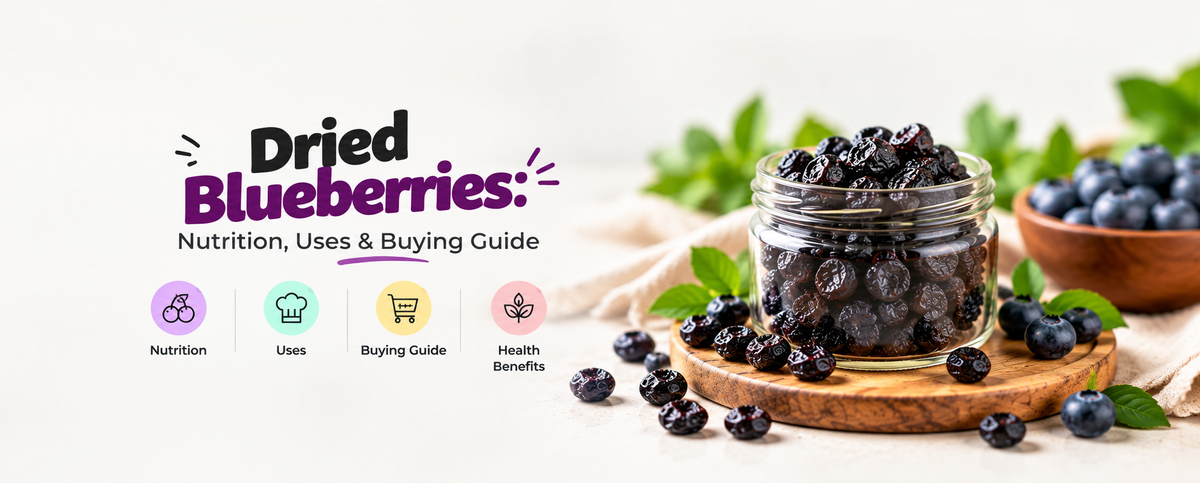
Dried Blueberries: Nutrition, Uses & Buying Guide
Dried blueberries have secured their position as one of the most popular dried berries available, and there's a good reason for that: they offer the same rich, antioxidant-filled flavour as fresh blueberries but are in a form that lasts for months, is easy to transport, and satisfies a sweet craving without having to reach for candy. Should you be looking to replace processed snacks with ones that actually enhance your day, it's important to properly understand dried blueberries — not just what they contain, but how they compare with fresh berries, what distinguishes a good product from a cheap imitation, and how to keep a bulk bag fresh for a long time after you've opened it. The following guide looks at all these points, enabling you to shop more intelligently and enjoy your snacks better.
What Are Dried Blueberries?
Dried blueberries are obtained from fresh blueberries by removing most of their water content, this being achieved either by sun drying, oven drying, or freeze drying, so that a smaller, chewier, and much more concentrated form of the original fruit remains. The process of drying enhances both the sweetness and the sourness of the berries, giving dried blueberries a stronger, almost wine-like taste when compared with fresh blueberries. Since they are one of the more popular dried berries found in the health food section, dried blueberries can be found in all sorts of places, such as trail mixes, baked goods, and simple snack bowls.

Dried Blueberries Nutrition: What's in a Serving
The nutrient content of dried blueberries is such that they can be considered a truly useful inclusion in a health-conscious diet, but the details differ according to whether the product is sweetened or remains in its natural, unsweetened form.
Typical Nutrient Breakdown (Unsweetened, per 100g)
Calories: Roughly 320–345 kcal
Carbohydrates: Around 66–82g
Natural sugar: Approximately 42–54g
Dietary fiber: 9–16g
Protein: About 2.5–3g
Fat: Approximately 0 to 1.2 grams, depending on the processing method
Typical Nutrient Breakdown (Sweetened, per 100g)
The sweetened dried blueberries, which are the type most often available in supermarkets, generally have about 317 to 320 calories per 100g, and their total sugar content is approximately 67 to 72g because of the sucrose that has been added during processing. Their fibre content is usually a little less than that of the unsweetened varieties, amounting to around 5 to 7.5g per 100g since the sugar added reduces the overall concentration of the fruit slightly.
Antioxidants and Micronutrients
Dried blueberries keep a large portion of the antioxidant property present in fresh fruit, especially that of anthocyanins, the pigment that gives them their deep blue-purple colour. They also contain small but significant amounts of manganese, vitamin K, and lutein and zeaxanthin, the two substances linked to eye health. The amounts of all these nutrients remain unchanged during drying; they just become more concentrated as the water content decreases.
Dried Blueberries vs Fresh Blueberries: What Actually Changes
This is one of the most frequently asked questions by people when they decide to eat dried blueberries as a regular snack, and the straightforward answer is that it depends on what you are aiming to achieve.

Calories and Sugar
The main difference between dried and fresh blueberries is concentration. Fresh blueberries contain about 80 to 85 calories and approximately 14 to 15 grams of sugar per cup. Since drying gets rid of most of the water, the same volume of fruit reduces greatly, and so a cup of dried blueberries can have more than 500 calories and 100 grams of sugar. This is not a fault with dried blueberries; it is just what occurs when the same fruit is concentrated into a smaller amount. The practical point to take away is regarding portion size: a handful of dried blueberries does not amount to a handful of fresh ones, and it is when people treat them as if they can be used interchangeably in a one-to-one ratio that they end up consuming too much without realizing it.
Fiber
It is interesting that dried blueberries tend to have more fibre per serving because when the water is removed, the fibre content of the fruit is concentrated together with its sugar. Some unsweetened dried blueberry products can contain as much as 9 to 16 grams of fibre in every 100 grams, whereas fresh blueberries have only about 3 to 4 grams per cup. This is a significant difference if you are concerned about your fibre intake.
Antioxidant Activity
It is often thought that drying destroys antioxidants, but research that has compared fresh, frozen, and dried blueberries generally shows no significant difference in antioxidant activity among the three types. In this case, the processing method is less important than people usually suppose — the antioxidant compounds remain essentially intact during the drying process.
Shelf Life and Convenience
Fresh blueberries are very delicate and generally only remain good for a few days in the refrigerator before they begin to go bad. On the other hand, dried blueberries can stay viable for months if stored correctly, which makes them a much more practical choice for people who would like a dependable, ready-to-eat snack without having to worry about it going bad or being available only during certain seasons.
Which Should You Choose?
- If you want blueberries that have a lower calorie density and more water content, select fresh ones and eat them within a few days of buying them, then choose fresh berries.
- When you want a shelf-stable, portable snack that has a high concentration of both fiber and flavor and are willing to manage portion sizes because of the high sugar and calorie content, choose dried blueberries.
It is better for most people to have both in rotation rather than considering one to be strictly superior to the other.
Everyday Uses for Dried Blueberries
Dried blueberries are versatile and can be included in almost any part of a daily diet, not only as a snack by themselves.
As a Standalone Snack
Having a few dried blueberries at your desk or in your bag provides a simple and satisfying option instead of grabbing chips or candy when you have a craving.
In Breakfast Bowls
Adding dried blueberries to oatmeal, overnight oats, or yogurt provides a natural sweetness and a chewy texture without it being necessary to use any added sugar or syrup.
In Baking
Blueberries that have been dried keep their shape when used in muffins, scones, and quick breads, whereas frozen berries tend to release moisture and can cause streaking in the batter. Because of their strong flavour, you usually need less sugar to be added to the recipe as a whole.
In Trail Mixes and Energy Bites
Dried blueberries are often used as a base when making homemade trail mix and no-bake energy balls together with nuts and seeds, offering a convenient way to obtain natural energy for hikes, workouts, or long afternoons.
As a Salad or Grain Bowl Topper
Dried blueberries, when added to green salads and grain bowls, provide colour, sweetness, and a certain texture, and they help to counteract the bitterness of the greens or the tang of the dressing without requiring a separate dessert.
How to Choose Good Quality Dried Blueberries
Since different products marked 'dried blueberries' have different nutritional values, a bit of time spent reading the labels will help when you're buying in bulk.
Read the Ingredient List First
A quality genuine dried blueberry product must have blueberries listed as the first ingredient; if the product says 'blueberry flavour', has an unnamed fruit base, or includes plum or some other fruit used as a filler before blueberries appear, then you are probably looking at an imitation rather than the real product.
Understand Sweetened vs. Unsweetened
When commercial dried blueberries are processed, they are given a light coating of sugar and sunflower oil in order to improve both their texture and appeal on the shelf. This practice is not in itself a problem, but if you are aiming to reduce the amount of added sugar, you should look for products that are labelled 'no added sugar' or 'unsweetened', since these will have blueberries as their only ingredient.
Check the Color and Texture
Good dried blueberries ought to be a deep, natural blue-purple in colour and should have a slightly wrinkled but firm texture — they should not be flat, too hard, or have an artificially uniform shape. Sometimes an unnaturally shiny or bright appearance may be a sign of the addition of colour rather than indicating a naturally dried product.
Consider the Country of Origin
Blueberries that have been dried and that come from areas famous for producing high-quality blueberries — such as the United States, Canada, and certain parts of South America, including Chile — usually have more dependable standards when it comes to sourcing and processing. One simple thing you can do is to check the country of origin listed on the label in order to get an idea of the quality of the product you are purchasing.
Buying in Bulk: What to Look For
When buying dried blueberries in large quantities, make sure to check the packaging date and choose vacuum-sealed or resealable bags rather than those in loose, open bins since the latter are more likely to come into contact with air and moisture. Although buying in bulk is an excellent method of saving money on dried blueberries, this cost-saving measure only works if the product is fresh to start with; otherwise, a good price for a stale batch isn't really a good bargain.
How to Store Bulk Dried Blueberries
One of the most cost-effective methods of having a healthy snack available is to buy blueberries in bulk, but it is essential to store them properly if you want the bulk purchase to remain fresh for months rather than becoming stale within weeks.
Keep Them Airtight
One of the main causes of flavour loss in dried fruit is exposure to oxygen, so after you have opened the bulk bag, transfer the blueberries into a sealed glass jar, a resealable freezer bag, or another airtight container rather than keeping the original packaging only loosely closed.
Store in a Cool, Dark Place
Both heat and light accelerate the breakdown of the flavour and nutrients in dried blueberries, so the best place to store them is on a shelf in the pantry, away from the stove or direct sunlight. When stored in this way, dried blueberries generally remain fresh for about six months to a year.
Refrigerate or Freeze for Long-Term Bulk Storage
Refrigeration greatly prolongs the shelf life if you have bought a large amount, and freezing extends it even more—sometimes by a year or so, provided that it is kept in a sealed, airtight bag with the excess air squeezed out before the bag is closed. It is particularly advisable to do this in warmer or more humid areas since storing the food at room temperature causes a quicker deterioration of its quality.
Portion Before Storing
When making bulk purchases, it is advisable to divide the blueberries into smaller, resealable portions before freezing rather than having to open the large bag repeatedly. This helps to reduce the number of times the bulk of your supply is exposed to air and moisture, thus keeping the remaining blueberries fresher for a longer period of time.
Watch for Spoilage Signs
If the blueberries are dried out, remove them because they show signs of mould, have an off odour, or appear abnormally sticky, which indicates that moisture has gotten in. Berries that are too hard or dusty have probably dried out more than was intended and, although not necessarily unsafe, will not have the same taste or texture.
Quick Storage Reference
|
Storage Method |
Typical Shelf Life |
|
Airtight container, room temperature |
6–12 months |
|
Airtight container, refrigerated |
12+ months |
|
Airtight container, frozen |
12–24 months |
Conclusion:
Dried blueberries provide a truly practical solution for satisfying a sweet craving while also giving your daily intake a real amount of fibre and antioxidant benefits, matter of fact whether you eat them directly from the jar, mix them into your breakfast, or bake them into a more indulgent dish. If you know how they stack up against fresh blueberries, can tell the difference between a good product and an imitation, and understand the correct way to store a bulk buy, then you'll get greater value and improved flavour from each batch. Having a good supply of dried blueberries available makes it a lot more feasible than it appears to replace processed snacks with something better. CLICK HERE to get quality dried blueberries for your pantry.









Share:
Dried Berries: Types, Nutrition, Uses, and How to Choose Them