


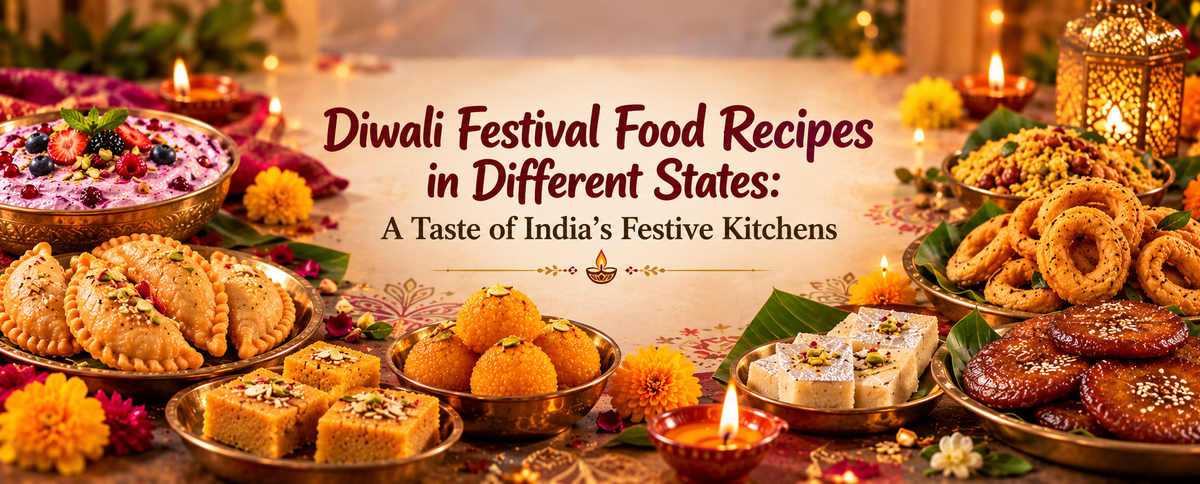
Diwali Festival Food Recipes in Different States: A Taste of India's Festive Kitchens
Ask anyone what they remember most about Diwali and food comes up within seconds: the smell of ghee in a Punjabi kitchen, a tray of karanji cooling in Pune, a pot of jaggery syrup bubbling for adhirasam in Chennai. This guide brings together Diwali festival food recipes from different states, with simple, step-by-step methods you can follow at home. You will cook your way through Punjab, Maharashtra, Gujarat, Karnataka, Kerala, Tamil Nadu and Kolkata, learn the history that explains why each dish belongs on the table, and finish with fruit and frozen-fruit ideas for a lighter, fresher festive spread.

What Is Diwali About? A Short History, and Why Food Sits at the Centre
Diwali, or Deepavali, is the festival of lights, celebrated on the new-moon night of the Hindu month of Kartik, usually in October or November. At its heart is the idea of light overcoming darkness, but the story attached to it changes by region: Rama's return to Ayodhya, Krishna's victory over Narakasura, the worship of Lakshmi, the legend of King Bali, Mahavira's nirvana for Jains, and Bandi Chhor Divas for Sikhs.
The festival is old. References to lamp-lit celebrations appear in ancient Sanskrit literature, including the Puranas, and the seventh-century play Nagananda by Emperor Harsha mentions a festival of lamps. The eleventh-century scholar al-Biruni described people lighting lamps in India around this time of year. Many historians also link Diwali to the end of the monsoon and the autumn harvest, which explains why new grain, jaggery, ghee and fresh produce feature so prominently in festive cooking.
Food is how the festival travels from temple to home. Sweets are offered to deities, then shared with neighbours; savoury snacks are prepared in bulk so there is always something for visitors. Each region cooks with what it grows: wheat and ghee in the north, rice and coconut in the south, chhena in the east, besan and sesame in the west. Read on for the recipes.
Diwali Festival Food Recipes in North India: Punjab
Punjab celebrates Diwali alongside Bandi Chhor Divas, and the sweet most closely tied to the occasion is karah prasad, the warm, glossy wheat halwa offered in gurdwaras. It uses only three ingredients in equal measure, which is why technique matters more than the shopping list.
Karah Prasad (Atta Halwa)
Serves: 6 | Time: about 30 minutes
Ingredients
- 1 cup whole wheat flour (atta)
- 1 cup ghee
- 1 cup sugar
- About 3 cups water
- A few chopped almonds (optional)
Method
- Bring the water and sugar to a gentle boil in a pan, stir until dissolved, and keep it hot.
- In a heavy-bottomed kadhai, melt the ghee on low heat. Add the flour and roast, stirring constantly, for 12 to 15 minutes until it turns golden brown and smells nutty.
- Carefully pour in the hot syrup, a little at a time. It will splutter, so stand back and keep stirring.
- Cook for 3 to 4 minutes until the halwa thickens and the ghee begins to separate at the edges.
- Garnish with almonds and serve warm.
Tip: Rushing the roasting step leaves a raw flour taste. Patience gives the deep, toasty flavour.
Diwali Festival Food Recipes in West India: Maharashtra and Gujarat
Maharashtra: Karanji

Maharashtrian homes prepare faral, a platter of snacks and sweets shared with family and neighbours. Karanji, a crisp half-moon pastry filled with coconut and sugar, is its sweetest star.
Makes: about 15 | Time: 1 hour
Ingredients
- Dough: 1 cup refined flour (maida), 2 tablespoons hot ghee, a pinch of salt, water to bind
- Filling: 1 cup grated dry or fresh coconut, ½ cup powdered sugar or grated jaggery, 1 tablespoon roasted poppy seeds, ½ teaspoon cardamom powder, 1 tablespoon chopped nuts
- Oil or ghee for frying
Method
- Rub the hot ghee into the flour and salt, then knead a stiff dough with water. Cover and rest for 30 minutes.
- Lightly roast the coconut for 2 to 3 minutes, cool, and mix with the remaining filling ingredients.
- Roll small circles of dough, place a spoonful of filling on one half, wet the edges, fold and press firmly. Crimp with a fork or fluted cutter.
- Fry on medium-low heat until light golden and crisp. Cool completely before storing.
Tip: Seal the edges well, or the filling leaks into the oil.
Gujarat: Mohanthal
Gujarat's Diwali table is known for fine, fragrant sweets. Mohanthal, a fudge-like square made from gram flour, is a Lakshmi Puja favourite.
Makes: 16 pieces | Time: 45 minutes
Ingredients
- 1 cup coarse gram flour (besan)
- ¼ cup ghee, plus extra for roasting
- 2 tablespoons milk
- ¾ cup sugar and ⅓ cup water for the syrup
- ½ teaspoon cardamom powder, a pinch of saffron, chopped almonds and pistachios
Method
- Rub ¼ cup ghee and the milk into the besan until it resembles breadcrumbs. Rest for 15 minutes, then sieve to get a grainy texture.
- Roast the mixture in a spoonful of ghee on low heat for 12 to 15 minutes until it turns golden and fragrant.
- Make a sugar syrup with the water and sugar until it reaches a one-string consistency. Add cardamom and saffron.
- Add the syrup to the roasted besan carefully and stir well. Spread in a greased tray, top with nuts and let it set for a few hours. Cut into squares.
Tip: Do not over-roast. The flour should turn golden, not brown.
Diwali Festival Food Recipes in Karnataka and Kerala
Karnataka: Kodubale

These crunchy, ring-shaped snacks are a Karnataka classic, spiced with green chilli and coconut. Chiroti and holige also appear on the festive table, but kodubale is the easiest to make at home.
Makes: about 25 | Time: 50 minutes
Ingredients
- 1 cup rice flour
- ¼ cup gram flour (besan)
- ¼ cup grated coconut
- 1 green chilli, finely chopped
- 1 teaspoon each of cumin and sesame seeds
- 1 tablespoon hot ghee, salt to taste
- Oil for frying
Method
- Mix the flours, coconut, chilli, cumin, sesame and salt. Add the hot ghee and rub it in.
- Add hot water a little at a time and knead into a smooth, firm dough.
- Roll small pieces into thin ropes and join the ends to make rings.
- Deep fry on medium heat until golden. Cool and store in an airtight tin for up to two weeks.
- Tip: Frying on high heat browns the outside and leaves the inside raw. Keep it medium.
Kerala: Sweet Poha
Diwali is a quieter festival in Kerala than Onam, and it is observed mainly by Konkani, Tamil, Gujarati and Marwari communities. Konkani families in Kochi often serve sweet flattened rice on the morning of the festival, and its no-cook simplicity makes it a good one to try.
Serves: 4 | Time: 15 minutes
Ingredients
- 2 cups thick poha (flattened rice)
- ½ cup grated jaggery
- ½ cup fresh grated coconut
- ½ teaspoon cardamom powder
- 1 tablespoon ghee, a few roasted cashews
Method
- Rinse the poha briefly in a sieve so it softens without turning mushy. Drain well.
- Mix with jaggery, coconut and cardamom. Rest for 10 minutes so the jaggery melts into the poha.
- Heat the ghee, roast the cashews, and fold them in. Serve at room temperature.
Tip: Use thick poha. Thin varieties turn pasty.
Diwali Festival Food Recipes in Tamil Nadu and Kolkata

Tamil Nadu: Adhirasam
A dense, chewy, jaggery-sweet disc made from rice flour, adhirasam is a Deepavali essential. Tamil families also take Deepavali marundhu, a ginger-pepper-jaggery paste, after the feast to settle digestion.
Makes: 12 | Time: 45 minutes, plus resting
Ingredients
- 1 cup raw rice, soaked for 2 hours, drained, spread to dry for 30 minutes and ground to a fine flour (or 1 cup store-bought rice flour)
- ¾ cup grated jaggery and ¼ cup water
- ½ teaspoon cardamom powder, 1 teaspoon sesame seeds
- Oil for frying
Method
- Melt the jaggery in the water, strain, and boil until a drop forms a soft ball in cold water.
- Add the flour, cardamom and sesame, stirring to make a soft, sticky dough. Cover and rest for 8 to 12 hours.
- Grease your palm, flatten a lemon-sized ball into a thick disc, and fry on low heat, pressing gently, until deep brown.
- Drain and press lightly with a ladle to remove excess oil.
Tip: The syrup stage decides everything. Too thin and the dough is mushy; too hard and the adhirasam turns brittle.
Kolkata: Narkel Naru
In Bengal, Kali Puja is the highlight, and homemade coconut laddoos known as narkel naru are a typical offering and a favourite at the end of a meal. Sandesh and payesh share the table, but this one needs no special moulds.
Makes: 12 | Time: 25 minutes
Ingredients
- 2 cups frozen grated coconut
- 3/4 cup sugar (or jaggery for a deeper taste)
- 1/2 teaspoon cardamom powder
- 1 tablespoon ghee
Method
- Cook the coconut and sugar together on low heat in the ghee, stirring until the mixture loses its moisture and starts to come together, about 12 to 15 minutes.
- Add the cardamom and let it cool until warm to the touch.
- Shape into small balls while still warm and let them set.
Tip: Do not brown the coconut. A pale, creamy colour gives the right soft texture.
Fresh Fruit and Frozen Fruit Ideas for a Lighter Diwali Table
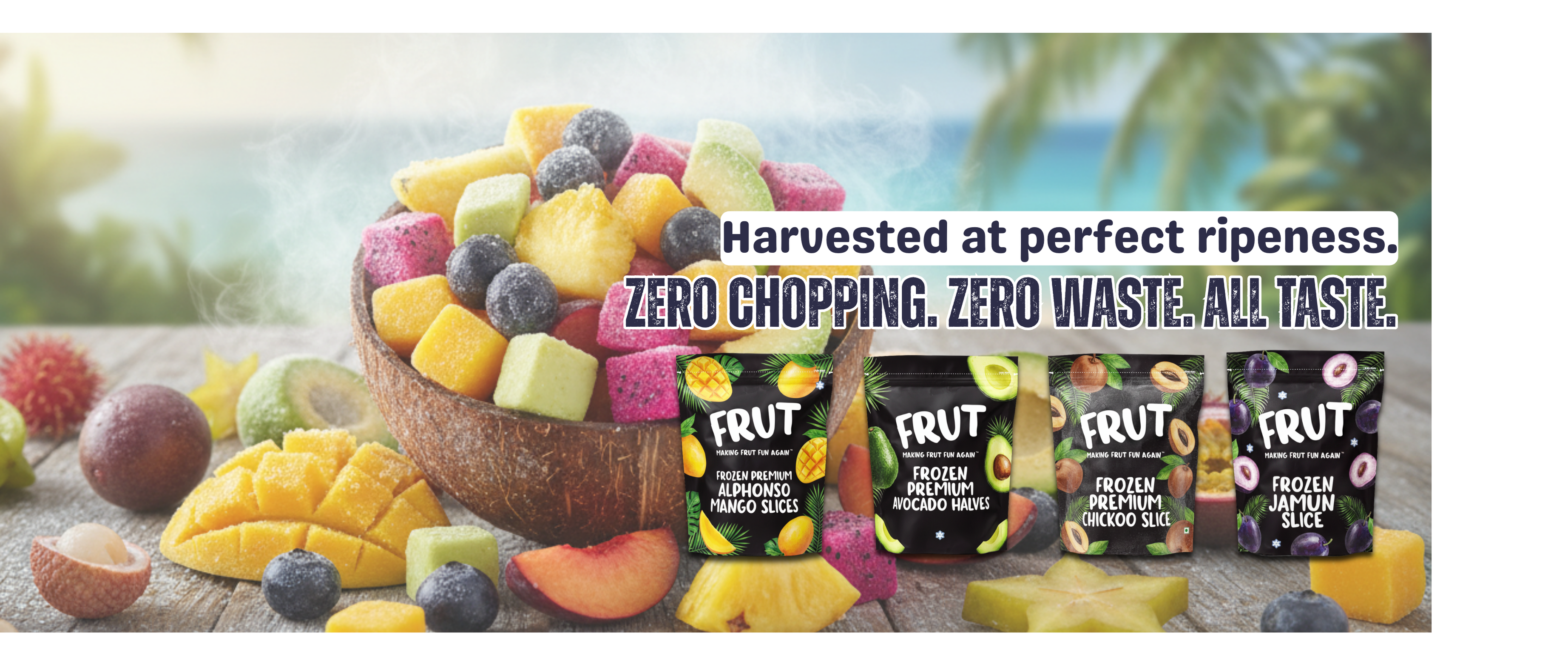
After days of ghee, fried snacks, and sugar, a fruit-led dessert feels like a gift. Fresh fruit is also a long-standing part of Diwali: pomegranates, apples, grapes, guavas, sugarcane and dry fruits are exchanged as gifts and offered during Lakshmi Puja. Frozen fruit helps when something is out of season or you want to prepare in advance, since berries and mango pulp are usually frozen soon after harvest and keep most of their nutrients. Check the label for added sugar.
Frozen Mixed Berry Shrikhand
Shrikhand is a cooling Maharashtrian and Gujarati dessert, and berries lend colour and tang.
- Hang 2 cups of thick curd in muslin for 4 to 5 hours until it becomes dense.
- Thaw ½ cup frozen mixed berries and mash lightly.
- Whisk the hung curd with 2 to 3 tablespoons of honey or powdered sugar and ½ teaspoon of cardamom.
- Fold in the berries, chill for 2 hours, and top with pistachios.
Frozen Mango Kulfi
- Blend 1½ cups frozen mango slices with ½ cup thick curd or cream and 2 tablespoons of honey until smooth.
- Pour into moulds or small cups, and freeze for 6 to 8 hours.
- Unmould and serve with a few chopped pistachios.
Pomegranate and Apple Chaat
- Toss chopped apple, guava, and pomegranate seeds with lemon juice, a pinch of black salt, and chaat masala.
- Add roasted makhana for crunch and serve as a palate-cleansing starter between rich courses.
For readers watching sugar, these three options sit comfortably beside traditional sweets and pair well with a small portion of mithai rather than replacing it.
Frequently Asked Questions
1. What is Diwali about, in simple terms?
Diwali is the festival of lights, marking the victory of light over darkness and good over evil. Different regions link it to different stories, such as Rama's return to Ayodhya, Krishna defeating Narakasura, Lakshmi's blessings or the legend of King Bali.
2. Which sweets are traditionally made for Diwali?
It depends on the state. Punjab has karah prasad, Maharashtra karanji, Gujarat mohanthal, Karnataka chiroti and holige, Tamil Nadu adhirasam and Bengal sandesh and narkel naru. Besan laddoo and kaju katli are popular almost everywhere.
3. Can I make Diwali sweets ahead of time?
Yes. Dry items such as kodubale, karanji and chakli keep well for one to two weeks in airtight tins. Milk-based sweets like shrikhand and kulfi should be made a day or two ahead and kept refrigerated or frozen.
4. Are frozen fruits as healthy as fresh ones?
For most purposes, yes. Fruit is generally frozen soon after picking, which preserves much of its vitamins and fibre. Choose unsweetened packs and thaw gently for desserts, or use straight from the freezer in smoothies and kulfi.
5. How do I make Diwali sweets a little healthier?
Use jaggery or dates for part of the sugar, bake or air-fry instead of deep-frying where it suits the dish, and keep portions small. A fresh fruit dessert at the end of the meal also helps balance the richness.
Conclusion
Cooking Diwali festival food recipes in different states is one of the most enjoyable ways to understand India's festival. Karah prasad connects you to Sikh tradition, karanji to a Maharashtrian kitchen, and adhirasam to a Tamil one, while fresh and frozen fruit keep the spread bright and balanced. Pick two recipes from different regions, make them together with family or friends, and share the story behind each dish as you serve it. CLICK HERE to buy your healthy after a joyful festival from FRUT.



Share:
Speculoos Spread Overnight Oats: 5 Easy Variations You'll Actually Crave